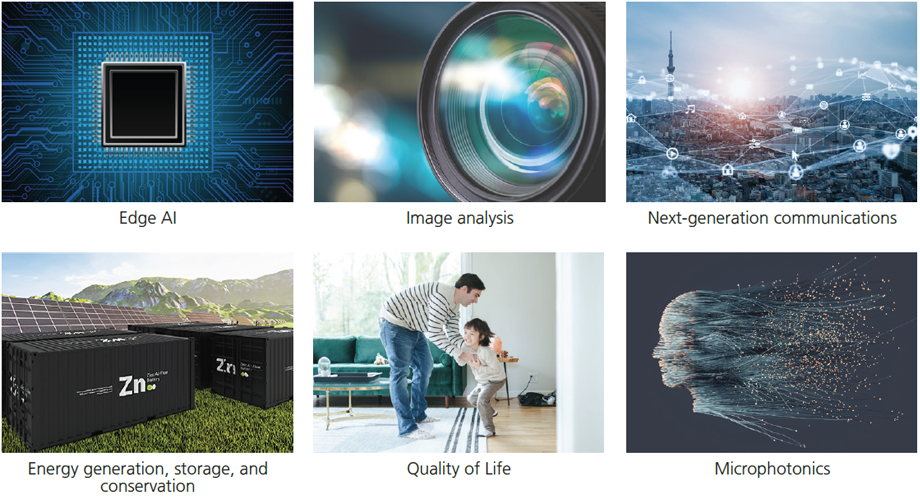
Our corporate R&D divisions will lead company-wide new business creation and Next Innovation through the creation of core technologies for our regrowth and leap stages.
We will advance and deploy the following core group of technologies across all companies: edge AI technology aimed at application and deployment to all business domains; image analysis technology as the foundation of labor-saving DX; next-generation mobile communication technology that supports social infrastructure in the AI era; environmentally conscious technologies for energy generation, storage and conservation; Quality of Life for enriched living; and micro photonics, the foundational technology of the Brand and Device businesses.
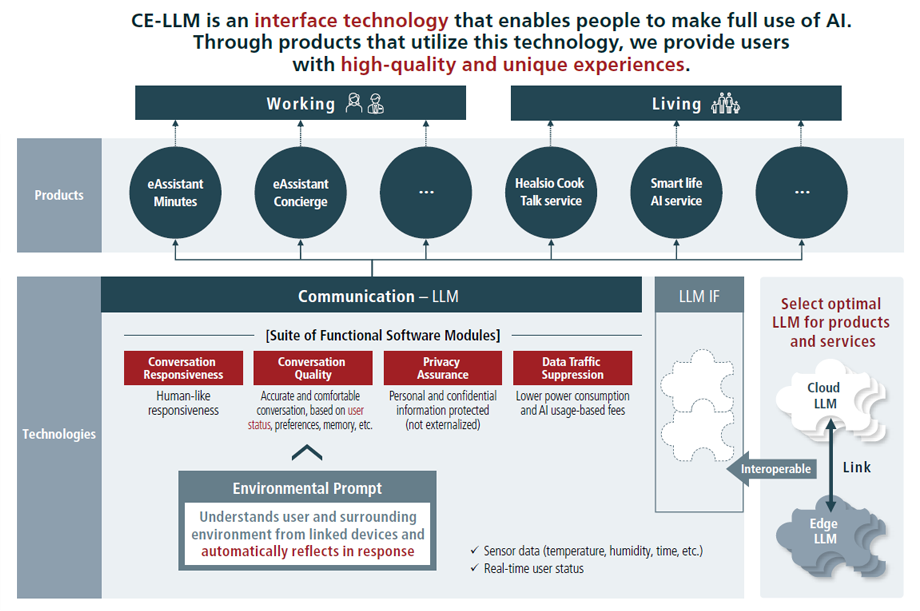
In the rapidly evolving field of AI, Sharp focuses on strengthening the development of our proprietary edge AI technology, CE-LLM. CE-LLM features an Environmental Prompt, which automatically inputs information on a user’s surrounding environment into AI in real time, and optimized switching between edge AI and cloud AI. These features not only enhance conversation responsiveness and quality but also assures privacy and reduced data traffic. Sharp will leverage CE-LLM to provide new people-oriented AI solutions.
To accelerate the creation of new innovations, we aim to bring R&D projects to market quickly by uniting the collective strength of the Sharp Group through the group-wide project I-Pro. We also actively collaborate with a wide range of partners, such as startups and creators, and working on value creation in line with the Sharp identity.
In our efforts to explore future technologies, we aim to create new value by advancing and integrating our core technologies in fields with high growth potential, and accelerate Next Innovation.
In emerging industrial areas such as mobility, industrial DX & robotics, and space, we will leverage the strengths of Sharp’s distinctive technologies, pursue Sharp’s identity, and take on the challenge of fostering new businesses.
In line with changing customer needs in the mobility market, we accelerate Sharp’s unique EV development that focuses on the time vehicles are stationary. In industrial DX and robotics, we strengthen the development of Sharp’s image analysis, robot control, and applied AI technologies, and connect these technologies with future physical AI.
Furthermore, we leverage our distinctive technologies accumulated over the years to explore future business opportunities in the space field, where interest is growing. Such technologies include our high-efficiency solar cells, mobile communications, and image analysis technologies.
Sharp positions its intellectual property strategy as one of the most important management strategies,pursuing it together with business and R&D strategies. We work to enhance our business advantage and strengthen our management foundation by actively obtaining patents.
Sharp IP Infinity Co., Ltd. has thorough knowledge of Sharp products, technologies, and businesses. Utilizing this knowledge, the company will provide advanced services as the company enforces improvements in the quality and efficiency of professional services. In doing so, Sharp IP Infinity will enhance the driving force of intellectual property management and generate strong patents and various economic values with the advanced technologies of Sharp. In regard to patent acquisition, Sharp clarifies the core technological fields for each of our businesses and works closely with the field to make strategic patent applications. We also actively work to obtain useful patents generated through alliances with other companies or industry-academia collaborations.
In recent years, standardization activities have become recognized as a tool for corporate management strategies to create markets and secure competitive advantages. At the same time, there is also an urgent need in Japan to strengthen competitiveness by attaining international standards.
In 2003, we established a research institute to acquire patents for wireless communication technology standards and participated in the standardization of LTE launched at the 3GPP*1 meeting in 2004. Since then, we have continued to participate up through the standardization of Beyond 5G. Sharp holds more than 8,500 communication standard-essential patents in more than 50 countries around the world, including a top-level number of 5G standard-essential patents among corporations in Japan. We utilize this stock of patents as an important management resource to Sharp.
Furthermore, we actively engage in international collaborations with overseas companies and universities, focused on pursuing international standardization of next-generation communication and video coding technologies in particular. We also actively send young employees to international conferences to gain various experiences, aiming to develop highly skilled human resources.
Award recognizes contributions to industrial standardization, including the development of international standards and domestic specifications, as well as conformity assessment activities
Award recognizes achievements in R&D of wireless link technologies aimed at attaining international standards for advancing 5G through Japan–U.S. industry–academia collaboration