Compliance
Compliance
| Fiscal 2025 Objectives | Fiscal 2025 Achievements | Self-Evaluation | Priority Objectives for Fiscal 2026 |
|---|---|---|---|
|
|
★★★ |
|
- Self-evaluation:
- ★★★ Achieved more than targeted
- ★★ Achieved as targeted
- ★ Achieved to some extent
Compliance Policy
In its Sharp Group Charter of Corporate Behavior and Sharp Code of Conduct, which draw on the Business Philosophy and Business Creed, the Sharp Group has proclaimed that it will practice fair and open management based on sincerity and creativity. We have also formulated the Basic Rules for Compliance, in which we define compliance as observing laws, regulations, and company rules, and acting in line with corporate ethics. Based on this definition, we prioritize compliance by always asking ourselves what is good for society.
System to Promote Compliance
The person most responsible for leading compliance in the Sharp Group is the CEO. Basic policies for compliance are formulated and firmly put in place within the Group under the global outlook of the CEO, and the head of the Corporate Legal Group, who is responsible for promoting compliance across the Sharp Group, plans and implements specific compliance measures, monitors their implementation status, and plans and implements corrective actions. Among the laws and regulations that pertain to business execution, some are considered to be critically important and capable of affecting the entire Sharp Group. For each of these material categories of laws and regulations, we designate a responsible department. Each department fully analyzes the content of and trends in these laws and regulations and studies the effects they could have on business. We then review—as needed—business operations and processes, revise internal regulations, formulate or revise routine operation standards, communicate these changes, and provide guidance and supervision to executives and employees.
The presidents of the business units are responsible for compliance within their respective organizations. The business unit presidents are also responsible for guiding and supervising compliance measures at subsidiaries and affiliated companies (hereinafter, “subsidiaries”) under their business units. Promoting compliance at each subsidiary in and outside Japan is the responsibility of the respective president.
If a compliance-related risk occurs, we will respond appropriately in accordance with the Rules for Business Risk Management, take corrective measures, and prevent recurrence.
Compliance Training
In addition to formulating internal rules related to various categories of laws, the Sharp Group pursues compliance through its Sharp Group Compliance Guidebook. This guidebook, which has been revised and disseminated throughout the company, states defined standards for matters to be observed, matters which are prohibited, and actions to be taken for all executives and employees.
We also periodically carry out training (including e-learning) on the Sharp Code of Conduct and material categories of laws and regulations (such as competition laws, anticorruption, and personal information protection).
In fiscal 2025, the training was open to 16,751 employees including those at Sharp Corporation, subsidiaries in Japan, and the labor union, with 16,482 taking part (98.4% participation rate).
The Sharp Code of Conduct was communicated to employees at all Sharp overseas subsidiaries. In addition, in fiscal 2025, an external law firm conducted training on Japan's revised Subcontract Act for all employees.
Hotline for Compliance Issues
Hotline for Sharp Corporation and Its Affiliated Companies in Japan
In line with revisions to Japan’s Whistleblower Protection Act in June 2022, Sharp Corporation and its affiliated companies in Japan have established the Crystal Hotline, a comprehensive whistleblowing and reporting channel for compliance-related concerns in the workplace, such as work-related violations of laws, and words and actions that are counter to the Sharp Group Charter of Corporate Behavior, the Sharp Code of Conduct, in-house rules, social norms, and ethics. We have also set up a competition law hotline, which serves as a contact point specifically for issues related to competition laws. These hotlines have been set up both inside the company and externally (via an outside law firm providing legal counsel). They are available via email, phone, and other means for employees and temporary staff, as well as business partners*, to make reports. The Crystal Hotline also accepts anonymous reports. We also have a consultation service dedicated to addressing workplace harassment (which includes sexual harassment, harassment related to pregnancy and childbirth, and abuse of authority).
- Only the Crystal Hotline is available for use by employees of business partners.
Handling of Hotline Reports
The hotlines and consultation service receive reports and conduct fact-finding investigations in line with strict operating rules. The investigation results and responses to the problem are conveyed to the person who submitted the report or requested a consultation. If the investigation reveals any violation of laws, regulations, or company rules, or any other compliance issues (actions counter to social norms or ethics), we will put into effect measures for remediation and recurrence prevention.
Number of Whistleblowing Reports in Fiscal 2025
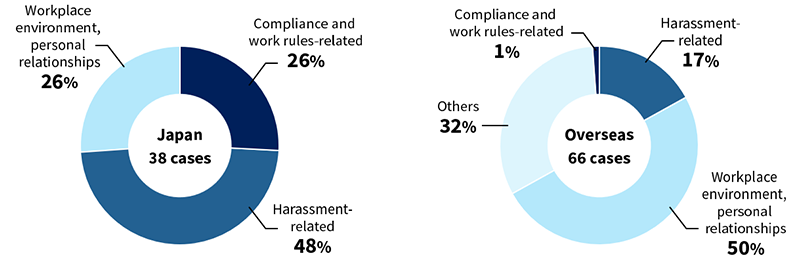
In fiscal 2025, the Crystal Hotline received 61 reports and the harassment consultation service received two reports. For each of these, we investigated the facts, implemented improvements where necessary, and provided corrective guidance. Meanwhile, the competition law hotline received zero reports in fiscal 2025.
Measures to Protect Whistleblowers
The hotlines are operated in line with the clear stipulation of both the Sharp Code of Conduct and the rules governing hotline service operation that information identifying the individual contacting the hotlines and details of the individual’s report will be strictly protected and that those persons will suffer no unfavorable treatment or penalties. Such rules are thoroughly communicated to all executives and employees through training and other means. Six months after the response to a report has been completed, we check whether the whistleblower who contacted the Crystal Hotline has suffered any disadvantage. We also check, after a certain period has passed following completion of the response, whether the corrective actions and recurrence prevention measures are working effectively. If any problems are found, we will verify the facts and implement further corrective action.
Hotlines at Overseas Affiliates
Hotlines have been set up at Sharp’s major overseas bases, with consideration for the legal system and other matters in each country. Action is taken to swiftly address any problems. In fiscal 2025, there were 56 reports.
In-House Information on the Whistleblowing System
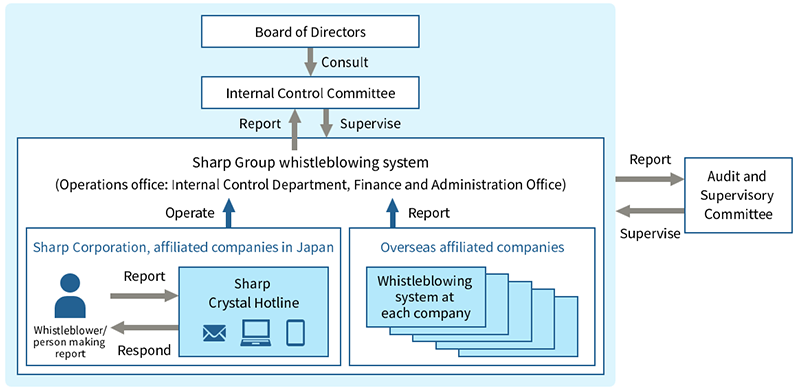
The number of cases in and outside Japan and their summaries are reported regularly to the Internal Control Committee, which is chaired by the president & CEO, and to the Board of Directors and the Audit and Supervisory Committee. These reports help provide an overall picture of company-wide governance.
The Sharp intranet has an overview of the Crystal Hotline as well as information such as its organization chart, how responses are handled, and the number of reports it receives. We publish summaries of reports while taking care to protect confidential information by, for example, omitting any details that could lead to the identification of specific cases.
Sharp Group Whistleblowing System Organization Chart
Breakdown of Whistleblowing Cases in Japan and Overseas in Fiscal 2025
Compliance with Competition Laws
In order to comply with Japan’s Act on Prohibition of Private Monopolization and Maintenance of Fair Trade, as well as with equivalent overseas laws and treaties enacted to protect the interests of consumers by maintaining and promoting free and fair markets (hereinafter, “competition laws”), we have put in place rules across the entire Sharp Group on observing competition laws. We have also created an Antimonopoly Act Compliance Manual (Action Guidelines). These guidelines stipulate basic compliance matters that employees must adhere to in their duties with regard to cartels.
To raise awareness amongst employees, we have prepared and revised a guidebook summarizing the key points of competition laws for each field of business, and we carry out periodic internal training via e-learning. We also raise awareness internally of case studies relating to competition laws from within Japan and internationally as well as information on major revisions to the laws.
When considering raising product prices in response to rising costs, we take steps to ensure strict compliance with competition laws, such as sending out internal notices, to prevent violations like taking part in cartels. We prevent competition law-related risks in transactions from occurring by reviewing all contracts and consulting with our legal department when approving new contracts.
To more effectively prevent competition law risks, such as cartel activities and bid-rigging, the legal and other relevant departments monitor the status of compliance by confirming the dealings and interactions of high-risk business departments with competitors and requiring high-risk business departments to report on their compliance status. Such efforts maintain the effectiveness of Sharp’s compliance program.
Preventing Corruption in All Forms and Dealing Properly with Donations
General Policy
The Sharp Group Charter of Corporate Behavior and the Sharp Code of Conduct contain provisions that strictly prohibit any form of corrupt behavior, such as extortion or direct or indirect bribes of money, goods, or services. The Group Charter and Code of Conduct also stipulate that donations must be handled in a proper manner.
The Sharp Group Compliance Guidebook follows the Sharp Group Charter of Corporate Behavior and the Sharp Code of Conduct in stipulating policies, for example, on providing gifts and entertainment to public officials, and on prohibiting bribery.
We also have the Rules for Prohibition of Bribery (hereinafter “the Rules”), which detail the actions that both executives and employees should and should not take in order to prevent corruption such as bribes, and which describe Sharp’s system for preventing bribery (see below). Under the Rules, we are continuously working to clarify and strengthen an internal checking system and prevent any act of bribery. In order to make material amendments to or abolish the Rules, in principle, a proposal must be submitted to the Executive Management Meeting, which is chaired by the CEO and comprised of executive officers.
Systems and Rules for Preventing Bribery and Other Forms of Corruption
We have established a clear and effective system for preventing acts of bribery, including the offering of entertainment, gifts or invitations to government officials and others, the providing of entertainment or gifts to executives and staff in private businesses, the use of agents, consultants and other third parties (hereinafter “third-party intermediaries, such as agents”), or the leveraging of memberships in organizations. This system includes an internal approval process that uses a checklist covering material points that must be confirmed in advance by the relevant departments. In addition, we have established prohibitions and determination criteria for each of the following.
1. Offering entertainment, gifts, or invitations to government officials and others
The Rules specify the maximum amounts, and prohibited matters, for offering entertainment, gifts, or invitations to public officials. The Rules define “facilitation payments” as “small payments made for the sole purpose of facilitating the smooth execution of routine administrative procedures by public officials.” The Rules clearly state that these payments are considered a form of bribery and are prohibited in principle.
2. Using third-party intermediaries, such as agents
The Rules stipulate that the use of third-party intermediaries, such as agents, is permitted only when there is a reasonable basis from which to confirm that remuneration and other payments to these third parties are not likely to constitute bribery. In addition, in our contracts with third-party intermediaries, such as agents, they are required to comply with our prohibition of bribery as well as the anti-corruption laws of each country, and we carefully monitor these third parties to ensure that they do not engage in any acts of bribery.
Working with Business Partners
We only deal with business partners who agree to abide by our Basic Purchasing Principles, which were created to prevent acts and omissions like bribes and unfair actions.
We also ensure that our business partners abide by the Sharp Supply-Chain CSR Deployment Guidebook, aimed at preventing inappropriate profits.
Working with Overseas Affiliates
Sharp’s overseas affiliates also follow the Sharp Group Compliance Guidebook and the Sharp Code of Conduct, which stipulate rules that employees must abide by, such as avoiding bribery and other corrupt actions.
In order to ascertain the risk of bribery and corruption among overseas affiliates and institute a more effective checking system, we have investigated and analyzed risks of potentially corruptive actions at overseas affiliates. Based on the results, we have proceeded to update our overseas affiliates’ internal rules of anti-bribery and introduce to overseas affiliates the bribery risk management processes utilized at Sharp in Japan, depending on the level and type of risk at each overseas affiliate.
Raising Awareness within the Sharp Group
To raise awareness among Sharp Group employees in Japan and overseas, we have created and published an in-house guidebook and training materials, which give information on anti-corruption and anti-bribery laws and describe real world examples. We also conduct annual in-house training related to preventing bribery and other corrupt actions. Sharp’s intranet for affiliates in Japan and its global intranet for overseas affiliates periodically feature articles on bribery and corruption in Japanese, English, and Chinese. These articles present bribery-and corruption-related cases and analyze and explain related issues. The aim is to deepen understanding and raise awareness of bribery among employees of affiliates in Japan and overseas.
As a result of these efforts, there were no violations of any bribery-related rules in fiscal 2025.
Dealing Properly with Donations
In Japan, we prevent illegal payoffs and improper expenditures through a system of reviews that check legality, reasonableness, and transparency. In place since December 2008, this system serves to assess the propriety of monetary disbursements such as donations and contributions made by Sharp Corporation and its affiliated companies. In fiscal 2025, eight cases of contributions were reviewed.
The Sharp Code of Conduct states, “Regarding political donations, we will observe all applicable laws and regulations and we will ensure transparency and proceed in strict conformance with internal company rules when making such donations in line with the company policy to build a healthy and responsible relationship with politics and government.” Based on this policy, any political donations abide by relevant laws and follow the necessary internal procedures.
Exclusion of Antisocial Forces
Basic Policy
As a matter of basic policy, we prevent or exclude any association with antisocial forces without exception, and deal with them in a resolute manner. We have established specific guidelines in the Sharp Group Charter of Corporate Behavior under the section entitled “Practice of Fair and Open Management,” as well as clearly stipulated in the Sharp Code of Conduct that we shall seek to exclude antisocial forces by being “cooperative in the maintenance of social order, and will not engage in antisocial activity.”
Activities Aimed at Excluding Antisocial Forces
Sharp Corporation has established Rules for Excluding Antisocial Forces, which serve as the basis for efforts to prevent transactions with antisocial forces. We also have a manual for dealing with such forces, which is updated and improved as needed.
We maintain a system of prompt cooperation with the police, legal advisors, and other external experts, from whom we regularly obtain information, which is then shared within the Sharp Group. We also ensure that this information is properly managed.
We also work to raise employee awareness by conducting once-a-year compliance training, which includes how to deal with antisocial forces.
In addition, Sharp Corporation and its affiliated companies in Japan take other steps to exclude antisocial forces, such as including a stipulation of antisocial forces exclusion in all basic agreements for ongoing transactions and concluding memorandums containing the equivalent stipulation with existing suppliers.
Management of Personal Information
Companywide Policy
The Sharp Group Charter of Corporate Behavior and the Sharp Code of Conduct clearly state the principles and standards of conduct to be followed to ensure strict management of the personal information of customers, business partners, employees, and others held by the Sharp Group.
With regard to the handling of the personal information of customers and business partners held by the Sharp Group, we have announced privacy policies and a privacy notice for business partners. For each of our services that handle customer personal information, we have formulated and announced privacy policies.
Personal Information Protection System and Regulations
We have appointed a chief information officer (CIO) and chief privacy officer (CPO). The CIO, who is responsible for overall information management across the company, oversees the information management department, responding to any issues that arise regarding information management across the company and promoting information management. In addition, the CIO appoints information managers in each business unit and affiliated company to implement measures related to information management.
Meanwhile, the CPO, who is responsible for personal information protection across the company, oversees the Personal Information Protection Team to promote measures related to personal information protection. In addition, the CPO appoints managers in each business unit and affiliated company to implement measures related to personal information protection.
As part of our efforts to protect personal information, we have established internal rules regarding personal information protection, as well as prepared a guidebook explaining these rules, and are working to ensure that these are thoroughly disseminated throughout the Group. Our internal rules and guidebooks are updated as necessary when relevant laws and regulations are enacted or amended.
To ensure the effectiveness of our efforts to protect personal information, processes that require approval from the department specialized in personal information protection (for customer personal information this is the Corporate Legal Group, for employee personal information this is the HR and administration department) are incorporated into our internal approval system regarding the handling of personal information. This contributes to consistently appropriate management of personal information obtainment, sub-processing, and provision to third parties by relevant departments. Also, following approval, the handling status—e.g., obtainment, storage, management, usage, deletion—of each customer’s personal information is to be recorded in our own management database and updated as needed so that it can be checked and reviewed by the Corporate Legal Group on an ongoing basis.
In addition, the Personal Information Protection Team takes the lead in using the management system to conduct audits of all departments that acquire customer personal information to check whether the information is handled in accordance with the contents of our management database. For specific departments that require stricter management, on-site audits are also conducted to ensure thorough management. As well, a case of unauthorized access spurred us to revamp our in-house security standards and step up security measures in our efforts to protect customers’ personal information.
At Sharp, we are building a data infrastructure that enables the integrated use of personal information acquired through each service, with the aim of providing our customers with solutions optimized for their needs. In this endeavor, we will comply with relevant laws and guidelines, including the Act on the Protection of Personal Information, and ensure that appropriate notification is given to and consent is obtained from our customers. Furthermore, we have implemented organizational and technical security measures to ensure proper management of personal information. We will strive to enhance and ensure the reliability of our information management system through continuous review and improvement.
Working with Business Partners
When personal information held by the Sharp Group is provided to a business partner, we require that the business partner handle the personal information appropriately and strive to ensure strict management of such information in accordance with the circumstances of the specific transaction being undertaken. This is done through the stipulation of various matters in the agreement concluded with the business partner, such as prohibitions on taking actions that would identify individuals or on using the information for purposes other than those intended and stipulation of the terms of data use.
Working with Overseas Affiliates
Data protection has become an increasingly important issue around the world. We have been sharing information with our overseas subsidiaries as part of periodic group-wide fact-finding surveys and risk analysis on the various areas related to the acquisition and processing of personal information in the EU and other overseas regions. Based on findings, we have been taking measures that include providing appropriate advance notice of personal data to be handled, concluding agreements that set forth necessary conditions, and putting in place internal rules required for proper handling of personal data. We are also raising awareness among employees by periodically issuing information about the enactment of—and amendments to—laws and regulations on global protection of personal information. Along with that, we share examples of financial penalties for breaches of these laws and regulations. This information is posted on the company intranet for all employees to see.
Raising Awareness within the Sharp Group
To ensure that personal information is appropriately managed and to prevent incidents of data leakage, we provide regular compliance training (including e-learning). In addition, individual training sessions are held for employees who handle personal information as part of their job duties.
Appropriate Advertising and Promotion, Representation-Related Law Compliance
Under our business creed of “Sincerity and Creativity,” we strive to reliably fulfill our corporate social responsibilities to customers and all stakeholders in the provision of correct information useful for selecting products and services. To this end, we prioritize appropriate advertising and promotion activities. We also comply with product and service representation-related laws, such as the Act against Unjustifiable Premiums and Misleading Representations, Pharmaceutical and Medical Device Act*1, and Fair Competition Code. We position compliance with these laws as a control item within our Rules of Business Risk Management, and implement various measures to promote compliance.
Systems and Rules for Preventing Legal Violations
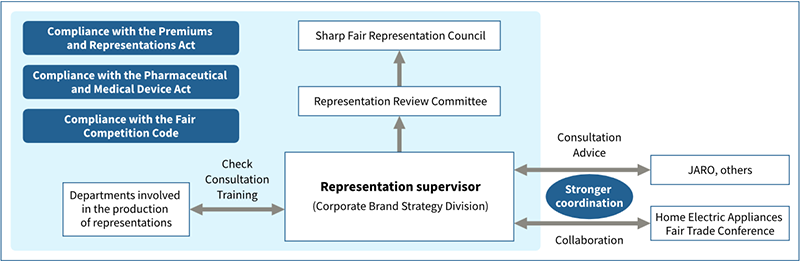
With regard to product and service representation within Japan, we operate in accordance with the internal rules listed below, which set out the basic principles for representation and a system for ensuring appropriate representations.
- 1. A dedicated supervisor is appointed to work with departments involved in the production of representations and to perform a final check prior to the publication of brochures and mass advertising
- 2. A senior committee is established to make decisions on potentially problematic representations (Representation Review Committee, Sharp Fair Representation Council)
- 3. Operations are carried out in line with the Fair Competition Code*2, formulated by the Home Electric Appliances Fair Trade Conference, with regard to product representations and premiums.
- 4. Public external organizations*3 are consulted for objective guidance and advice
We’ve developed an AI prototype that enables employees throughout the company to conduct basic reviews of representations. Following trials in relevant departments, we plan to put it into practical use during fiscal 2026.
Also, overseas, we follow local laws along with the Fair Expression Guidelines, which have been developed based on the same principles applied in Japan, in order to facilitate appropriate decision-making.
- Act on Securing Quality, Efficacy, and Safety of Products Including Pharmaceuticals and Medical Devices.
- Voluntary industry standards formulated by the Home Electric Appliances Fair Trade Conference and recognized by the Consumer Affairs Agency and Japan Fair Trade Commission.
- Home Electric Appliances Fair Trade Conference, Japan Advertising Review Organization (JARO), others.
Awareness Activities Boost Knowledge for Relevant Personnel
Awareness activities are held for employees in departments involved in the production of representations.
- 1. Training on the Premiums and Representations Act, Pharmaceutical and Medical Device Act, and Fair Competition Code
- 2. Encouraging employees to participate in seminars organized by the Home Electric Appliances Fair Trade Conference
- 3. Participation in outside seminars led by public institutions, and company-wide sharing of the latest trends and information obtained through these seminars
- 4. Provision of information through the Premiums and Representations Portal Site on the intranet
• Laws, public standards, in-house rules, revisions to laws and regulations, etc.
In fiscal 2025, there were no violations of the Premiums and Representations Act or the Pharmaceutical and Medical Device Act by the Sharp Group. We will continue to work to ensure there are zero violations in fiscal 2026.
Representation Review Framework
Adapting to Stricter Laws and Regulations
In response to the stealth marketing regulations that came into effect in Japan in October 2023, we have issued a company-wide caution notice and provided individual guidance to departments responsible for sales promotions, public relations, and other related activities.
Also, as a member of a project team established by the Home Electric Appliances Fair Trade Conference to review the Fair Competition Code, we are actively taking part in formulating responses to stealth marketing regulations for the electronics industry.
Tax Management Initiatives
Tax Policy
We demonstrate sincerity and creativity in our pursuit of sound business activities, in the process fulfilling our responsibilities as a member of society. A basic policy of the Sharp Group Charter of Corporate Behavior and Sharp Code of Conduct is the “Practice of fair and open management” in all corporate activities and operations, conforming to the laws and regulations of each country and region, international rules and company rules, as well as social norms and corporate ethics. Based on this basic policy, we work to maintain and improve compliance with tax laws and other tax-related regulations through proper payment of taxes and employee education.
Tax Governance System
The general manager of the Finance and Administration Office oversees tax obligations for the Sharp Group as a whole. In line with Sharp’s global tax policy, group companies have a responsibility to understand and comply with the relevant tax laws and regulations that apply to their operations. The Accounting Department in the Finance and Administration Office supports group companies and handles overall tax-related duties for the Sharp Group to reduce tax-related risk.
When faced with a tax-related issue, we work together with relevant affiliated companies in Japan and overseas and, when necessary, seek advice from tax professionals in order to address the issue. When the issue is deemed to be one of significant importance, it is reported to top management who then decide on a course of action.
Proper Payment of Taxes
Legal and regulatory compliance is our top priority, endeavoring to fulfill all fair and appropriate tax obligations. When filing tax returns, we do not seek to evade the legislative intent of the tax system nor engage in tax avoidance in violation of international tax rules. We endeavor to appropriately meet tax obligations while making use of preferential tax measures available to us as part of normal business operations.
In fiscal 2025, we recorded 15.3 billion yen* (Japan: 59%, overseas: 41%*) in corporate income tax.
- Based on Country-by-Country Report submitted to the tax authority.
Compliance with Transfer Pricing Rules
Regarding transactions with parties related to the Sharp Group, appropriate pricing is established based on the arm’s-length principle, in line with OECD (Organisation for Economic Co-operation and Development) transfer pricing guidelines and in accordance with each company’s functions and risks. We also draw up transfer pricing documentation based on the laws and regulations of each country. Also, for important transactions, we take steps, such as actively working with tax authorities to make use of APAs (Advance Pricing Arrangements), to reduce tax-related uncertainty, and to prevent double taxation.
Relationship with Tax Authorities
In order to maintain good relations with tax authorities, we endeavor to be diligent and responsive to the requests of tax authorities in each country, such as by providing them with information in an appropriate and timely manner. Whenever tax authorities raise questions about Sharp’s filing and payment of taxes, we examine the validity of their claims and, if we have an objection, may opt to formally file a petition against the tax authority with regard to the matter. However, if any corrective action is required, such action will be promptly implemented.
Specialized In-House Training for New Employees in Accounting
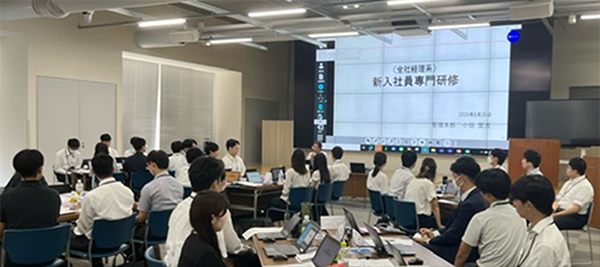
Every August, the Accounting Division of the Finance and Administration Office holds a three-day training program for new employees assigned to accounting-related roles. The program helps participants develop a solid understanding of proper accounting procedures and tax regulations.
The training program covers taxation, which includes corporate and consumption taxes, as well as consolidation, business administration, and practical accounting work at Sharp.