Corporate Governance
Corporate Governance
| Fiscal 2025 Objectives | Fiscal 2025 Achievements | Self-Evaluation | Priority Objectives for Fiscal 2026 |
|---|---|---|---|
|
|
★★ |
|
- Self-evaluation:
- ★★★ Achieved more than targeted
- ★★ Achieved as targeted
- ★ Achieved to some extent
Basic Policy
At Sharp, our basic policy on corporate governance is to maximize corporate value through timely and appropriate management while ensuring transparency, objectivity, and soundness supported by the concept, “Our future prosperity is directly linked to the prosperity of our customers, dealers and shareholders…” as stated in our business philosophy.
Based on this policy, we appoint outside directors who possess extensive knowledge and experience in areas such as social and economic trends and corporate management. By adopting a corporate structure that includes an Audit & Supervisory Committee, we are strengthening oversight of the execution of duties while enhancing the agility of decision-making. We have also introduced an executive officer system that clearly separates supervisory and decision-making functions from business execution functions, thereby creating a structure that facilitates nimble and efficient business execution. Also, we have clarified the profit responsibility of each Business Unit, by which we have been strengthening individual businesses and their operations and maintaining control through corporate headquarters.
In addition, we have formulated the Sharp Group Charter of Corporate Behavior as action guidelines for all directors, executive officers, and employees to raise their awareness of compliance, and we are working for its permeation across the entire Sharp Group.
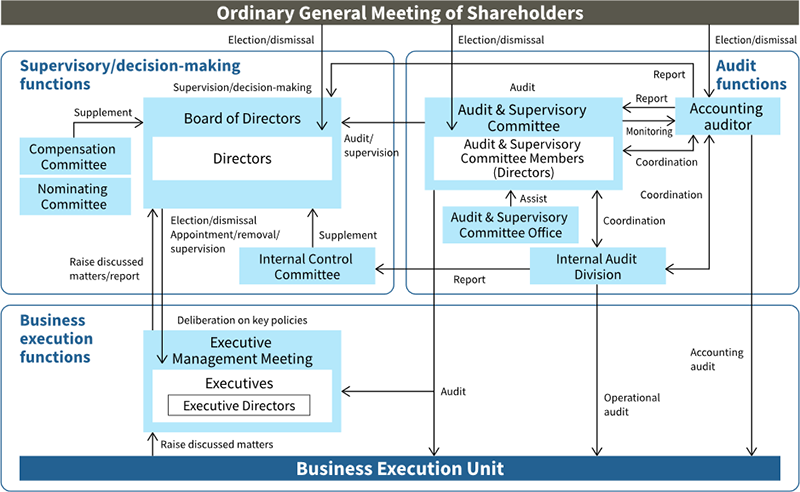
Corporate Governance System:
Supervisory and Decision-Making Functions
The Board of Directors of Sharp Corporation makes decisions on matters stipulated by law and on management-related matters of importance and supervises the state of business execution.
The Board of Directors comprises inside directors who are experts in the fields of business of the Sharp Group and outside directors appointed from talent with high specialism and abundant experience in fields such as social and economic trends and management.
We have established a voluntary Nominating Committee and Compensation Committee as advisory committees to the Board of Directors. The Nominating Committee recommends director candidates to the Board of Directors, and the Compensation Committee, under the authority delegated by the Board of Directors, determines the amount of monetary compensation for directors. As a way to strengthen corporate governance, the majority of members of both committees are independent outside directors and independent outside directors serve as the committee chairs. Additionally, important matters pertaining to transactions between the parent company group and the Sharp Group and that should be discussed at the Executive Management Meeting shall, before any decision is made, be subject to study and approval by the Board of Directors—the majority of whose members are independent outside directors—with regard to the necessity, reasonableness, and appropriateness of the transactions in question. On the Sharp website can be found the “Standards for Independence of Outside Directors,” which stipulates standards for judging the independence of outside directors.
In addition, we have established an Internal Control Committee to serve as an advisory committee to the Board of Directors. The Internal Control Committee discusses basic policy, maintenance and operation of internal control and internal audits, reports to the Board of Directors, and, when necessary, refers matters for discussion to the Board of Directors.
Composition of Supervisory and Decision-Making Organs
(As of June 25, 2026)
| All members (persons) | Inside directors (persons) | Outside directors (persons) | Non-directors (persons) | Chairperson/Committee chair | |
|---|---|---|---|---|---|
| Board of Directors | 9 | 4 | 5 | 0 | Chairperson: Chairman |
| Nominating Committee | 6 | 1 | 5 | 0 | Committee chair: Independent outside director |
| Compensation Committee | 7 | 2 | 5 | 0 | Committee chair: Independent outside director |
| Internal Control Committee | 8 | 3 | 3 | 2 | Committee chair: President & CEO |
Directors (Except Members of the Audit & Supervisory Committee)/Directors Who Are Audit & Supervisory Committee Members
(As of June 25, 2026)
| All members (persons) | Inside directors (persons) | Outside directors (persons) | Independent directors (persons) | Term | |
|---|---|---|---|---|---|
| Directors (except members of the Audit & Supervisory Committee) | 5 | 3 | 2 | 2 | 1 year |
| Directors who are Audit & Supervisory Committee members | 4 | 1 | 3 | 3 | 2 years |
Business Execution Functions
The Board of Directors’ rules stipulate matters on which the Board must decide. These matters include Sharp’s basic management policy, management plans, other important matters of management, and matters prescribed by laws, regulations, and articles of incorporation.
For decisions on other matters concerning management and business operations, we have established internal rules, including the Internal Authorization Rules, under which such matters are approved. For matters that are key to company-wide management and business operations, these are deliberated on at an Executive Management Meeting that comprises executive officers. The meeting convenes in a timely manner, which allows rapid management decision-making.
Audit Functions
The Audit & Supervisory Committee is composed of four directors, all of whom have a high level of expertise. Three members are independent outside directors, and one is a full-time member of the Audit & Supervisory Committee. Further, three of them possess extensive knowledge of finance and accounting.
The Audit & Supervisory Committee exchanges opinions periodically with executive directors, the accounting auditor, and the internal audit division, among others, and it seeks to attain legality, propriety, and efficiency in business execution. We have also established an Audit & Supervisory Committee Office composed of employees with specialisms in specific fields such as accounting and law, which supports the Audit & Supervisory Committee.
We undergo audits by our accounting auditor, PricewaterhouseCoopers Japan LLC. Through audits, we receive proposals on how to make operational improvements.
To preserve the independence of the internal audit division from the business execution divisions, an Internal Audit Division has been established directly under the jurisdiction of the president. It audits the legality and rationality of management, operations, and job execution across all business activities. Using the results, the divisions audited are given information, as well as advice and proposals to improve and streamline. This protects company assets, raises management efficiency, and strengthens the internal control system.
Management of Related Party Transactions and Others*
We have established the Regulations on Related Party Transactions. We manage these transactions so that they will not adversely affect our finances or business performance.
We have also created a list of related parties. When entering into business with the counterparty, we determine whether or not the transaction should be considered a related party transaction. This list is updated regularly and disseminated throughout Sharp and to consolidated subsidiaries in Japan and overseas.
Such transactions are subject to the same internal approval procedures as ordinary transactions. During this process, we assess the necessity, rationality, and validity of the terms and conditions. This allows us to exercise prudence when deciding on business deals.
Once a year we verify the content of transactions specified by outside directors, and the results are reported to the Board of Directors.
- Related party transactions and management-involved transactions: Related party transactions are transactions with a company or person having a certain level of connection with Sharp, including Sharp officers, subsidiaries, and major shareholders.
Management-involved transactions are transactions that Sharp management personnel have introduced or planned.
Corporate Governance System of Sharp Corporation (As of June 25, 2026)